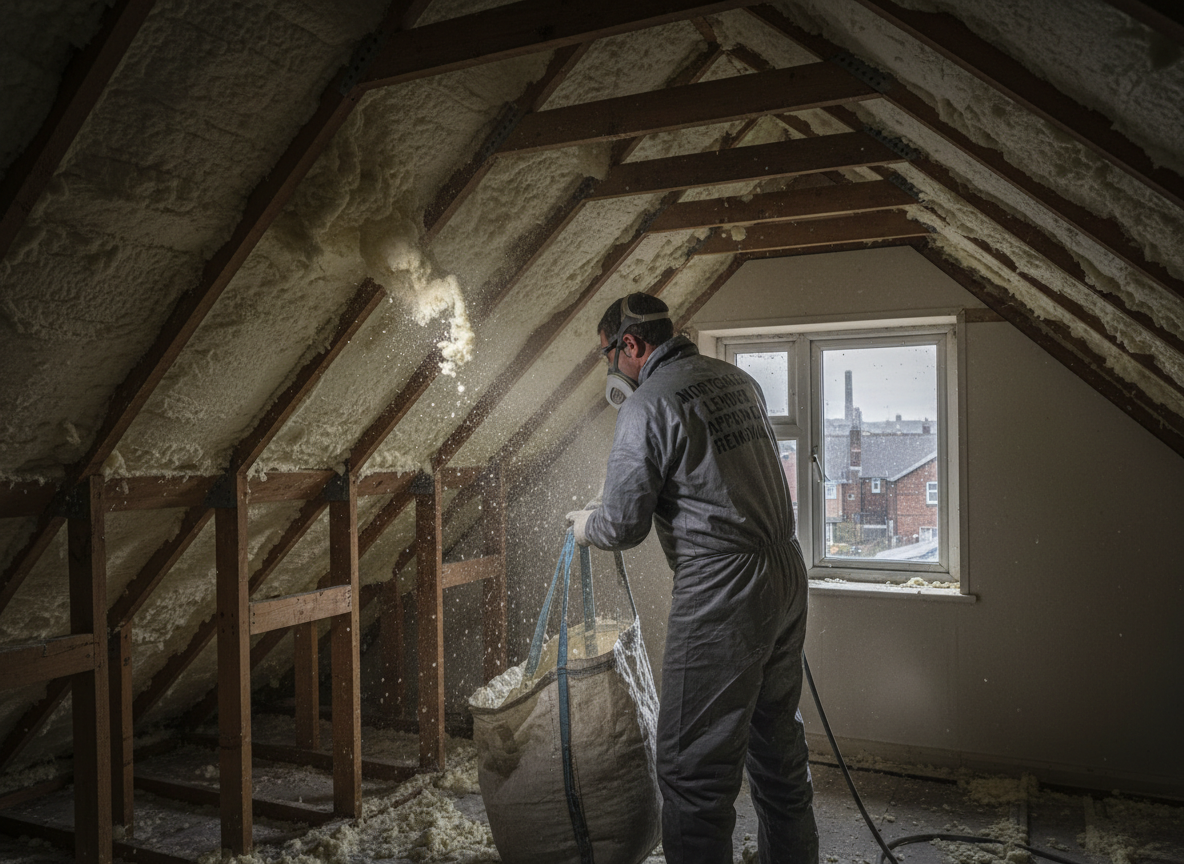
Sheffield's older housing stock, particularly Victorian and Edwardian terraces in districts such as Walkley and Netherthorpe, often contains closed-cell spray foam applied directly to rafters. Lenders frequently reject these installations because the foam traps moisture against timber and blocks ventilation paths required by building regulations. Removal demands careful mechanical scraping and vacuum extraction to avoid damaging original roof structures that have already settled over decades.
Winter weather in the Sheffield area accelerates problems when foam is present. Persistent rain and cold temperatures drive condensation into roof voids, and once lenders flag the issue during valuation, owners face tight timescales before exchange. Technicians must work around existing insulation layers, electrical cabling and water tanks while maintaining roof integrity, especially on properties with limited loft access common in South Yorkshire terraces.
Edge cases include foam that has been over-applied into eaves or around chimney breasts, creating hidden voids that only become visible after partial stripping. Local planning constraints around listed buildings near the city centre also affect disposal routes and working hours. Proper documentation of the cleared void, including photographs of restored airflow, is essential for resubmission to the lender.
Post-removal checks focus on timber condition and ventilation upgrades that meet current lender checklists. Homeowners in hilly areas like Crookes or Hillsborough often discover additional foam migration into wall cavities after initial loft work, requiring phased access that accounts for the steep terrain and narrow ginnels typical of the city.
Technician insight
In Sheffield, the thing that catches most people out with mortgage lender spray foam removal is how the steep pitched roofs on pre-1919 terraces in areas like Walkley trap the foam right into the eaves, so you end up chasing material down narrow accesses while the frequent rain keeps everything damp.
City Centre Terrace Mortgage Delay
A lender refused to proceed on a Walkley terrace until the closed-cell foam was removed from the roof void. Inspection showed foam blocking all eaves ventilation and extending into the party wall. Careful stripping restored airflow without disturbing settled timbers. The valuation was resubmitted with clearance photos and the mortgage completed.
How it works
- 1
Initial Lender Review
Examine the mortgage valuation report and identify exactly which areas of foam must be removed to satisfy the specific lender criteria.
- 2
Site Assessment
Visit the property to map foam locations, check roof access routes and note any secondary issues such as damp or cabling in Sheffield terraces.
- 3
Controlled Removal
Strip foam using hand and mechanical methods, contain debris and clear ventilation paths while protecting original timbers.
- 4
Documentation and Handover
Photograph the cleared void, confirm airflow restoration and supply the report package required for mortgage resubmission.
Pricing
Costs depend on property age, loft size and depth of foam; upfront quotes provided after inspection.