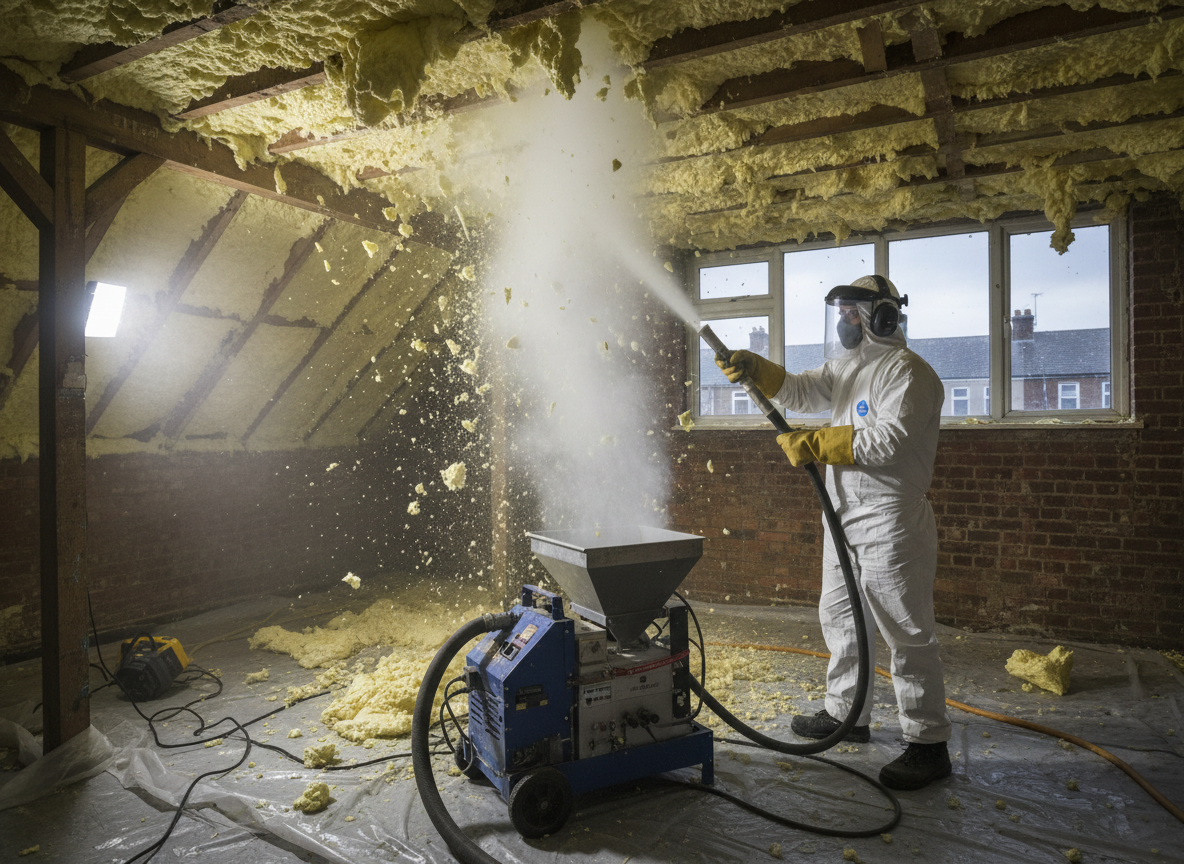
Sheffield's Victorian terraces and 1930s semis often contain closed-cell spray foam installed in the 2000s that has begun to trap moisture against roof timbers. Dry ice blasting removes the foam without sanding or grinding, preserving original lath and plaster ceilings common in Nether Edge and Crookes. The process uses solid CO2 pellets that sublimate on contact, eliminating the need for water or solvents that could worsen damp problems in the region's heavy rainfall.
Access in Sheffield city centre properties is frequently restricted by narrow loft hatches and steep pitches on the hills around the city. Dry ice blasting reaches between joists without dismantling ceilings, reducing the risk of disturbing asbestos likely present in homes built before 1980. Operators must monitor pellet feed rates carefully because the local stone and brickwork can spall if the nozzle is held too close on colder winter days when surfaces are more brittle.
After removal, the loft must be ventilated immediately to prevent re-condensation on exposed timbers. In Sheffield's damp climate this step is critical; many homeowners discover hidden rot only once the foam is gone. The method leaves no residue that could affect new insulation or electrical cables, a common concern in properties where wiring dates from the 1960s and 1970s.
Technician insight
In Sheffield, the thing that catches most people out with dry ice blasting spray foam removal is the way 1930s semis in areas like Walkley have foam bridging the original eaves ventilation; once removed you suddenly realise how little airflow the terraces actually get once winter temperatures drop and the foam had been masking the problem.
Foam removal in a Crookes terrace
Homeowner noticed musty smell after heavy autumn rain. Inspection found closed-cell foam trapping moisture against rafters in a 1920s terrace. Dry ice blasting cleared the foam without disturbing the original ceiling below. Timbers were left to dry with added ridge vents; no rot developed and the loft could accept new mineral wool insulation.
How it works
- 1
Site Assessment
Inspect loft access, foam depth, and any timber damage in Sheffield properties.
- 2
Protection Setup
Seal rooms below and protect electrics before starting dry ice blasting.
- 3
Blasting Removal
Apply CO2 pellets at controlled pressure to lift foam without substrate damage.
- 4
Clearance and Ventilation
Remove debris and open vents to dry timbers before new insulation.
Pricing
Cost depends on loft size, foam thickness and access difficulty in older Sheffield housing.