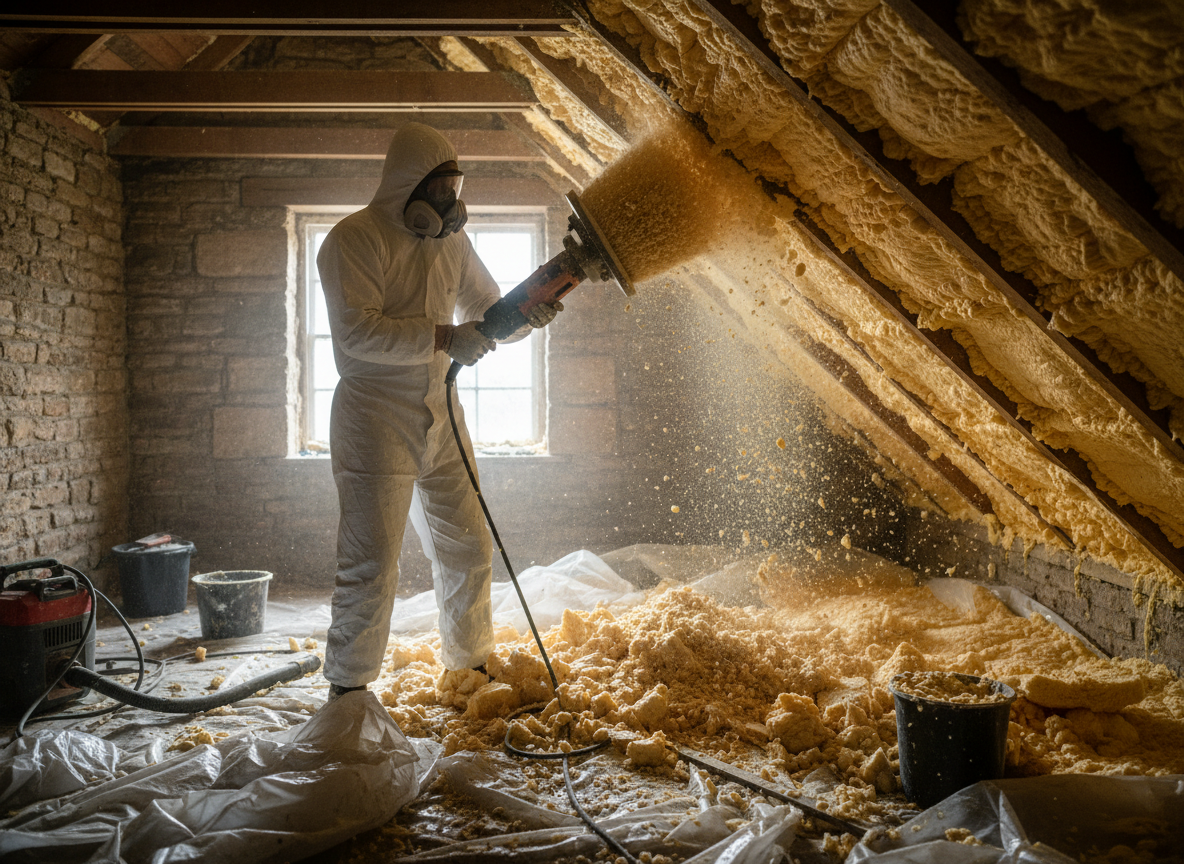
Closed cell spray foam bonds tightly to rafters and joists in Sheffield's Victorian terraces and Edwardian semis, common in areas like Crookes, Nether Edge and Walkley. In the region's wet climate, this adhesion often traps moisture against timber, leading to rot that only becomes visible after removal begins. Technicians must work section by section, using controlled heat and mechanical separation to avoid splitting original roof timbers that have already been stressed by decades of South Yorkshire rainfall.
Edge cases frequently arise in Sheffield City Centre conversions and hillside properties where foam was applied over existing insulation or into eaves with limited access. The dense material releases particulates during cutting, requiring full containment and negative air pressure to protect adjacent living spaces. Disposal must follow local waste rules for construction materials, and crews often discover hidden electrical cables or pipework embedded in the foam that demand careful rerouting before the job finishes.
Homeowners sometimes attempt partial removal themselves, leaving behind thin layers that continue to off-gas or block ventilation. Proper extraction includes checking for residual isocyanates and ensuring the roof space regains airflow suited to the area's variable weather. Work on listed or pre-1919 buildings in the Sheffield area also requires extra attention to original lath and plaster ceilings below the treated zones.
Technician insight
In Sheffield, the thing that catches most people out with closed cell spray foam removal is how the foam has bonded to the original rafters in 1890s terraces around Crookes or Walkley. Once winter temperatures drop and condensation builds behind the foam, any attempt to pull it in one go splits the timber and creates bigger repair work.
Closed Cell Removal in a Crookes Terrace
Homeowner noticed persistent damp smells in the attic of a late-1800s terrace. Inspection found closed cell foam trapping moisture against rafters. We removed the foam section by section, treated minor rot, and restored ventilation. The roof space dried out without further timber damage.
How it works
- 1
Site Assessment
Inspect attic, walls and roof structure in the Sheffield property to map foam depth, timber condition and any hidden services.
- 2
Containment Setup
Install dust barriers and negative air equipment to protect living areas from particulates during removal in older terraces.
- 3
Foam Extraction
Cut and peel closed cell foam in controlled sections, preserving rafters and addressing any rot found in damp South Yorkshire conditions.
- 4
Cleanup and Ventilation Check
Remove debris, vacuum residues and confirm restored airflow meets requirements for local housing stock.
Pricing
Cost depends on property age, foam thickness and access difficulty in Sheffield terraces; upfront quotes provided after inspection.